
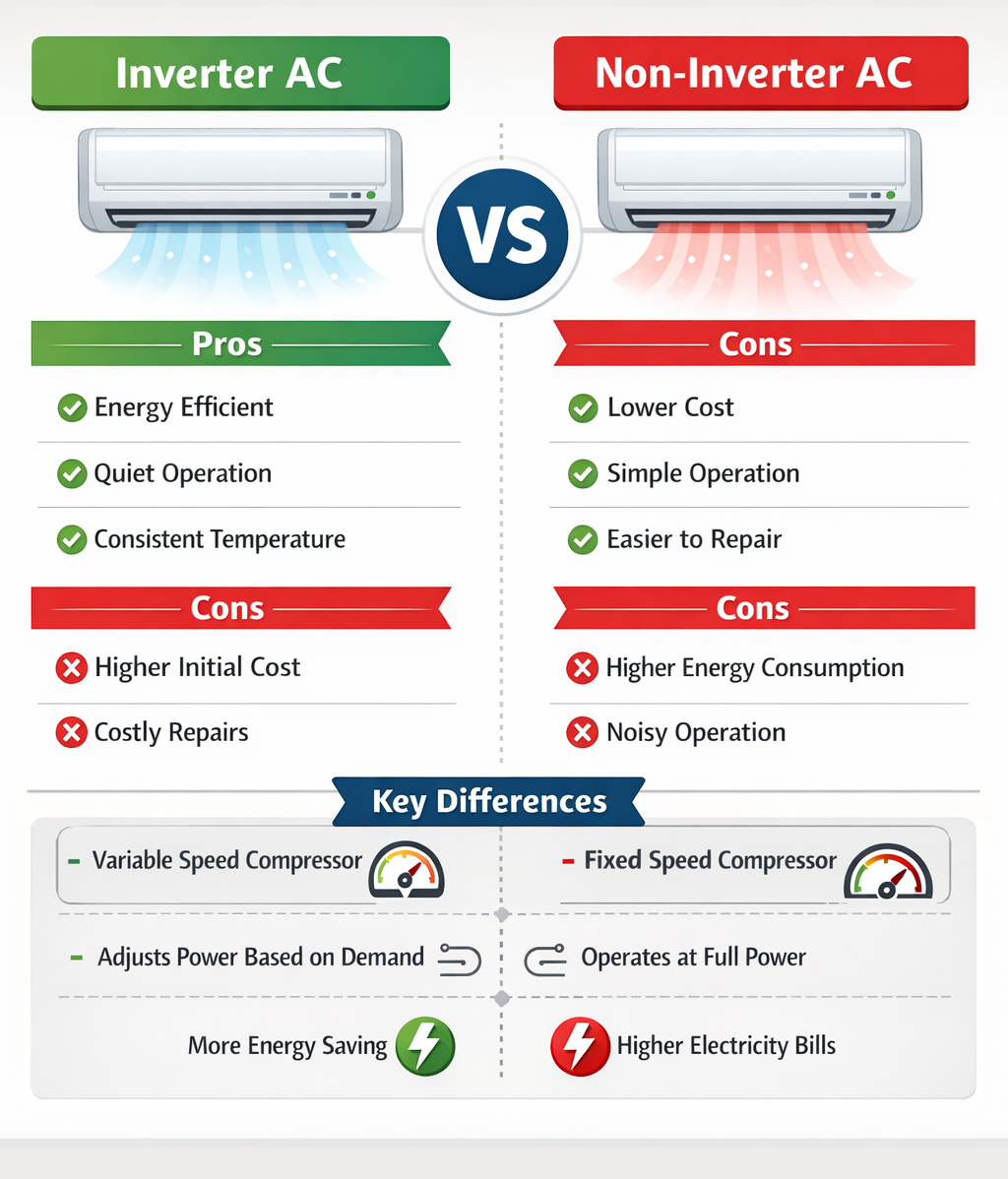
When choosing between an inverter and a non-inverter air conditioner, the main difference lies in how the compressor functions and how efficiently it manages cooling. An inverter AC uses a variable-speed compressor that adjusts its power based on the room’s temperature, providing consistent cooling, lower electricity consumption, quieter operation, and better long-term savings. However, it comes with a higher upfront cost. In contrast, a non-inverter AC operates with a fixed-speed compressor that switches on and off repeatedly to maintain temperature, leading to higher energy usage, more noise, and noticeable temperature fluctuations, though it is more affordable initially. If you use your AC for long hours daily, an inverter model is the smarter investment, while a non-inverter AC may be suitable for occasional or short-term use where budget is the primary concern.
Inverter vs Non-Inverter ACs
- Energy Efficiency
- Noise Levels
- Cost
- Temperature Control
- Environmental Impact
Understanding Inverter ACs
What Is an Inverter Air Conditioner?
An Inverter Air Conditioner uses a variable-speed compressor that adjusts its cooling output based on real-time room temperature and cooling demand. Unlike traditional fixed-speed compressors that rapidly switch between full power and off states, inverter compressors modulate their speed continuously. This means the compressor rarely turns fully off and avoids frequent start-stop cycles, delivering more stable temperature, lower power consumption, quieter performance, and faster cooling response.
How Do Inverter ACs Work?
Inverter air conditioners operate using a variable-speed compressor that modifies its speed based on the cooling demand of the room. Instead of repeatedly turning on and off like traditional models, the compressor runs continuously at different speeds to regulate temperature efficiently. This smooth and consistent adjustment helps maintain a steady indoor climate while reducing energy consumption and minimizing temperature fluctuations.
Inverter AC Advantages and Disadvantages:
| Pros | Cons |
| Energy efficient | Higher upfront cost |
| Quieter operation | Maintenance complexity |
| Environmentally friendly | Setup requires skilled technicians |
| Longer lifespan | Replacement parts may be costlier |
| Rapid cooling and heating | Complex technology |
| Reduced wear and tear | Requires consistent power supply |
Best Picks:
- Voltas 1.5 Ton 5 Star Inverter Window AC
- Panasonic 1.5 Ton 5 Star Wi-Fi Inverter Smart Split AC
- Lloyd 1.5 Ton 3 Star Heavy Duty Inverter Split AC
- Godrej 1.5 Ton 3 Star Window AC
- Blue Star 1.5 Ton 3 Star Inverter Split AC
Understanding Inverter ACs
What Is a Non-Inverter Air Conditioner?
A Non-Inverter Air Conditioner uses a fixed-speed compressor that operates at full power until the set temperature is reached, and then it shuts off entirely. Once the temperature rises again, the compressor restarts at full power. This ON/OFF operation results in sudden temperature swings, higher energy consumption, and louder noise compared to inverter models. Non-inverter ACs are a traditional, simpler technology and are often chosen for infrequent or short-duration use.
How Do Non-Inverter ACs Work?
Non-inverter air conditioners operate with a fixed-speed compressor that functions at maximum power until the desired room temperature is achieved. Once the set temperature is reached, the compressor completely switches off. When the room begins to warm up again, the compressor restarts at full capacity. This repetitive on-and-off cycle continues to regulate the indoor temperature.
Non-Inverter AC Advantages and Disadvantages:
| Pros | Cons |
| Lower initial cost | Less energy efficient |
| Simpler technology | Noisier operation |
| Easier and cheaper to repair | Temperature fluctuations |
| Suitable for occasional use | Higher electricity bills |
| No need for a consistent power supply | More frequent wear and tear |
| Simpler interface | Less environmentally friendly |
Best Picks:
- Daikin 0.8 Ton 3 Star Fixed Speed Split AC
- Blue Star 1.5 Ton 2 Star Fixed Speed Split AC
- Lloyd 1.5 Ton 3 Star Fixed Speed Window AC
- Hitachi 1.5 Ton 3 Star Fixed Speed Split AC
- Blue Star 1.5 Ton 3 Star Fixed Speed Window AC
Comparative Analysis: Inverter ACs vs Non-Inverter ACs
Energy Efficiency
Inverter ACs — Inverter air conditioners are built for superior energy efficiency. They automatically regulate the compressor speed based on the cooling demand, which helps reduce electricity usage and lower power bills. Since the compressor does not frequently switch on and off, energy wastage and sudden power surges are minimized.
Non-Inverter ACs — Non-inverter air conditioners are comparatively less energy-efficient because they operate at a constant compressor speed. The compressor repeatedly turns on and off to maintain the set temperature, leading to higher power consumption. This continuous start-stop cycle increases overall electricity usage, resulting in elevated energy costs over time.
Noise Levels
Inverter ACs — These air conditioners function more quietly as they eliminate abrupt compressor start-stop operations. The compressor runs smoothly at varying speeds, which significantly reduces operational noise. This makes inverter models an excellent choice for bedrooms, offices, or any environment where silent performance is preferred.
Non-Inverter ACs — These models generally produce more noise due to frequent compressor cycling. The sudden switching on and off can create noticeable sound disturbances, which may be inconvenient in peaceful settings. Although noise levels differ across models, non-inverter ACs are typically louder than inverter variants.
Cost
Inverter ACs — Inverter air conditioners usually come with a higher purchase price because of advanced technology and enhanced features. Maintenance costs can also be slightly higher due to sophisticated components. However, long-term savings on electricity expenses often balance the initial investment.
Non-Inverter ACs — These air conditioners are more affordable upfront, making them suitable for budget-conscious buyers. Even though operational costs may be higher due to greater energy consumption, the lower initial price makes them an attractive option for many households.
Temperature Control
Inverter ACs — Inverter models are highly effective at maintaining steady and accurate room temperatures. By continuously adjusting compressor speed, they respond efficiently to changing cooling requirements without major fluctuations. This ensures consistent comfort and a stable indoor climate.
Non-Inverter ACs — Non-inverter units operate at full capacity or shut off completely, which leads to noticeable temperature variations. The room may feel excessively cool when the compressor is active and warmer during idle periods. As a result, temperature consistency is less precise compared to inverter systems.
Environmental Impact
Inverter ACs — Inverter air conditioners are considered more environmentally friendly due to their energy-efficient performance and the use of modern refrigerants. Reduced electricity consumption lowers carbon emissions and minimizes overall environmental impact, making them a more sustainable cooling option.
Non-Inverter ACs — Non-inverter ACs generally have a higher environmental footprint. Their increased energy consumption and use of older refrigerants contribute to greater carbon emissions and strain on power resources. Nevertheless, because of their affordability, they remain widely used despite environmental concerns.
Difference between Inverter and Non-Inverter AC
Which Should You Choose: Inverter or Non-Inverter AC?
Here’s a simple guide to help you decide between inverter and non-inverter air conditioners based on different needs and usage situations:
Small Apartments:
For compact spaces, an inverter AC is a better option because it delivers efficient cooling with minimal noise. Its energy-saving operation makes it well-suited for smaller rooms and apartments.
Large Homes:
Inverter air conditioners work efficiently in bigger houses, especially when multiple AC units are operating at the same time. They help manage overall electricity consumption and significantly lower energy bills.
Office Spaces:
In professional environments where silent performance and steady temperature are essential, inverter ACs are highly recommended. They maintain consistent cooling while ensuring a calm and disturbance-free workspace.
Occasional Usage:
If the air conditioner will be used rarely or in a secondary area, a non-inverter AC can be a practical and economical choice. It offers effective cooling at a lower initial investment.
Regular Usage:
For households planning to run the AC frequently, an inverter model is preferable. These units are more energy-efficient, durable, and designed to handle continuous operation without excessive wear.
Limited Budget:
If affordability is your primary concern, a non-inverter AC may be the right choice. They come with a lower purchase price and simpler technology, making them easier and less expensive to maintain.
Conclusion
To conclude, the decision between an inverter air conditioner and a non-inverter air conditioner ultimately depends on your individual needs and usage patterns. If you value energy savings, silent performance, and accurate temperature regulation, an inverter AC is the better investment. On the other hand, if you have budget limitations and require a straightforward, economical cooling option for occasional use, a non-inverter AC can be a practical solution. Carefully assess your requirements and choose the model that aligns best with your comfort preferences and lifestyle.
Frequently Asked Questions (FAQs)
What is the difference between inverter and non-inverter AC?
An inverter AC features a variable-speed compressor that adjusts its operation based on cooling demand, ensuring higher energy efficiency and stable temperature control. In contrast, a non-inverter AC uses a fixed-speed compressor that repeatedly switches on and off, leading to greater power consumption and temperature fluctuations.
Is a non-inverter AC better than an inverter AC?
Both types have their own benefits and drawbacks. Non-inverter ACs are typically more affordable upfront and use simpler technology, but they consume more electricity and generate more noise. Inverter ACs, although costlier initially, provide better energy efficiency, quieter performance, and more consistent cooling.
Does a non-inverter AC require a stabiliser?
Yes, most non-inverter ACs generally need a stabiliser to safeguard against voltage variations. Their fixed-speed compressors are more vulnerable to damage from irregular power supply conditions.
Is a non-inverter AC suitable for home use?
Non-inverter ACs can be a good option for households with a limited budget and moderate cooling needs. While they effectively cool rooms, they may lead to comparatively higher electricity bills due to increased power consumption.
How does a non-inverter AC function?
A non-inverter AC operates with a fixed-speed compressor that runs at full capacity until the set temperature is achieved. Once the desired temperature is reached, the compressor turns off and restarts when the temperature rises again. This continuous start-stop cycle maintains room cooling.